
The Giant Lacewing- Here Today, and Hopefully Not Gone Tomorrow
By Jim Moore
I had lived in the mountains, where the Sierra and Cascade meet, for more than a decade before I met our featured creature for this Mountain Valley Bug Wild story. There it was by our front porch nightlight, along with scores of other nocturnal moths, midges, and other bugs. I often came home from my swing shift job well after darkness covered the land; and being a bug guy, I always looked forward to finding some new living life form by the night light.
With a little help from my old college Entomology textbook I determined that this was a so called ‘Giant Lacewing’ a member of the Order of insects called Neuropterans, and specifically within the Family called Giant Lacewings. Five years would go by before I saw another Giant lacewing; and as the years continued I would see a few of them almost every year.
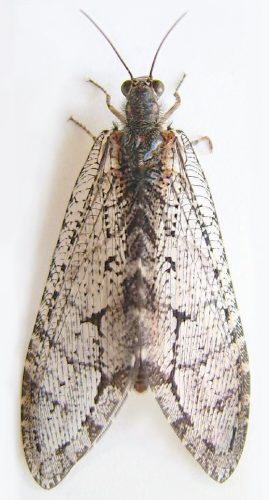
Later with the help of the BugGuide website, at Iowa State University, I learned that this Giant Lacewing (species Polystoechotes punctata) was an insect that was once common within cool forested montane habitats across North America, but is now virtually extinct in Eastern North America. The current range is from Western Canada south through the western mountain ranges as far as the country Panama. The reasons for its disappearance in the eastern United States and Canada are not fully understood since much of their forested habitats still exist. In California, this Giant lacewing has also disappeared from similar habitats near our large urban cities. Since Giant
Lacewings are attracted to night lights, it is believed by some scientists that artificial night light is a main culprit. Just type in ‘North America at night from space’ and you will see a huge difference between the East and the West. The East is lit up almost everywhere like an overloaded Christmas tree! Artificial light that stays on throughout the night has been shown to disrupt the breeding cycle of many nocturnal insect species, resulting in no reproduction. Perhaps the pervasive ‘glow’ of nearby cities reaching into the nearby wild habitats is likewise sufficient to do similar harm to nocturnal winged invertebrate animal life, including the extinction of the Giant Lacewing from its eastern range.
Fortunately, within the NorCal Mountain Valley region we can still see the stars; and so can our local nocturnal Giant Lacewings. These lacewings are big, with a body length up to 1.5 inches long, and a wing span up to 2. inches; about the size of a medium sized dragonfly. In spite of their large size they are not powerful flyers like daytime dragonflies. Most other lacewing species, like the common green lacewings, are much smaller with a wingspan of an inch or less.
The Giant Lacewing begins life as a subterranean grub-like larva. It was believed by some entomologist that the larva fed on plant roots; but recently it has been determined that they feed on soil mites and possibly other tiny invertebrates. When fully grown the larvae spin a cocoon and pupate underground. This is the overwintering life stage; with winged adults emerging and on the wing from June through October.
There is only one other Giant Lacewing species living in North America (species Platystoechotes lineatus); and it is limited in its range just to the Sierra Nevada Mountains in California as far north as Lassen County; where it is also observed in parks and campgrounds near outdoor night lights. I myself have never observed this species.
Recently in 2012 in the Eastern US, after being missing for about 60 years, a single specimen of Polystoechotes punctata was collected on the outside wall of a Walmart store in the state of Arkansas! It was also the first time this species had ever been found in Arkansas; showing that a population of these Giant Lacewings had been there all along. Lately I have not seen as many Giant Lacewings by my front porch light; but this is probably due to my decision to now keep the porch light off most of the time. This is my small effort so as not to disrupt nocturnal insects from their business of reproducing. Currently both Giant Lacewing species are still here today, and hopefully they will continue to exist here in future tomorrows!