By Stacy Fisher
Just a few months ago, tens of millions of people on the eastern seaboard were treated to the spectacular sight of a total solar eclipse, where the Moon’s dark central shadow, about 115 miles wide, swept northeast from Texas to Maine.
A total eclipse occurs periodically whenever the Sun, Moon, and the Earth are in alignment, inspiring awe and creating opportunities for science.
Everyone inside the shadow experienced the breathtaking sight when daylight suddenly darkens and the Sun’s majestic corona — the outermost part of the Sun’s atmosphere — becomes visible.
The celestial event was extremely popular, and reminds us that both our ancestors and modern humans are fascinated by the workings of the cosmos. It is a common refrain while gazing into the star-studded night sky to wonder, “How did everything come to be?”
Answering such basic questions seemed beyond our reach until the advent of telescopic instruments of sufficient power helped to fill in some of the gaps in our knowledge. Astronomers like Edwin Hubble, often lauded as the father of modern cosmology confirmed the universe was expanding using the 100-inch Hooker Telescope at Mount Wilson Observatory, announcing his finding in 1929.
Although modest in size compared to scientifically important observatories found worldwide that endeavor to unravel the universe’s deepest mysteries, the not-for-profit Chico Community Observatory offers the opportunity for anyone interested to learn something about remote objects in outer space, and for visitors to discuss many of the cosmic questions they may have with knowledgeable docents hosting the night’s events.
The observatory, built in the summer of 2001 is on city land and managed by CARD (Chico Area Recreation & Park District).
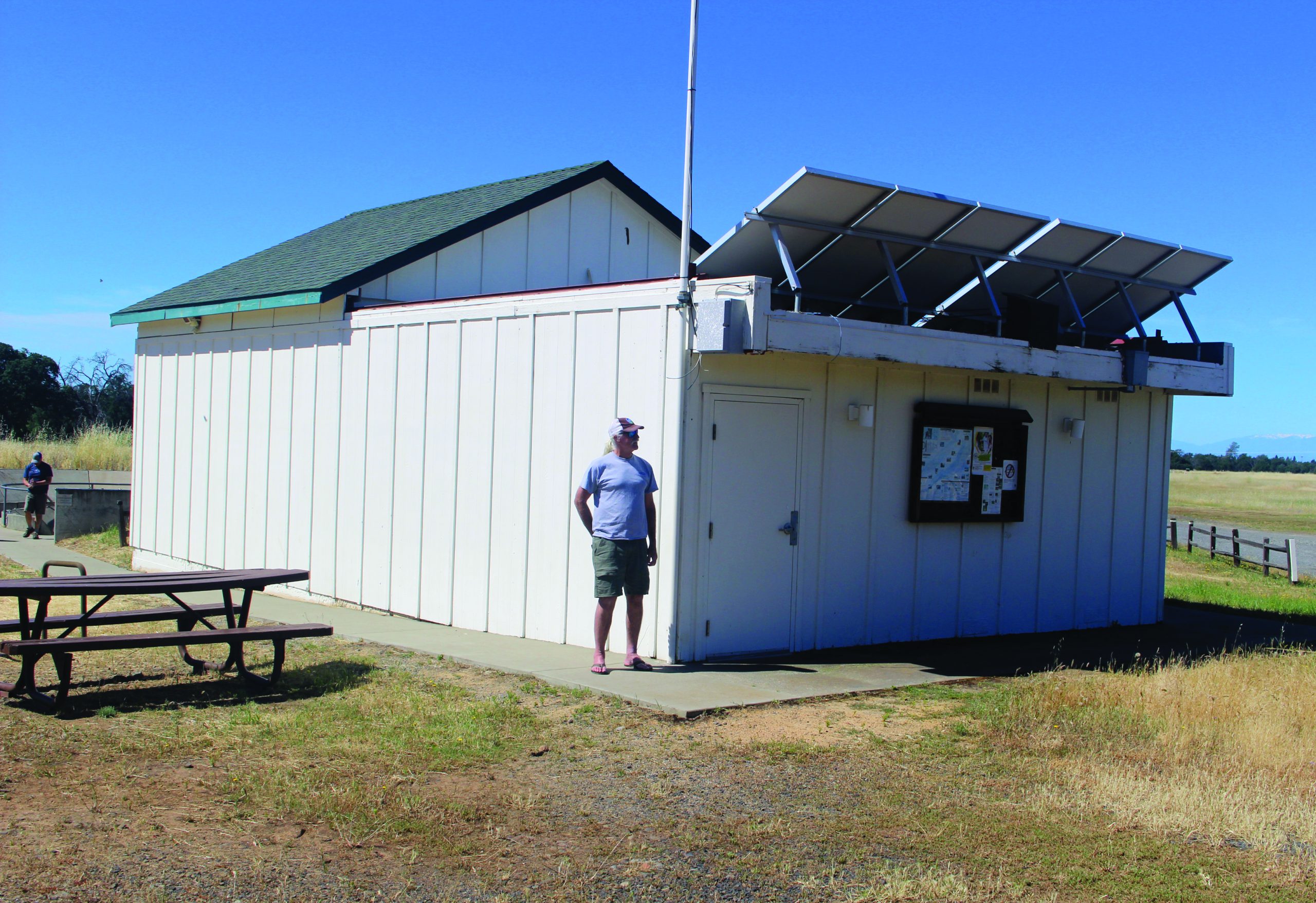
Free to the public, the observatory, located on the outskirts of town is available for people of all ages to observe the night sky and appreciate the marvels of the heavens, says Chico Observatory Director and docent Dan Puser. He has also served as a board member for the past eight years.
Docents are enthusiastic members of the community or professional educators who have astronomy knowledge, he says, who volunteer to give talks on various astrophysical topics.
However, not all volunteers have a background in astronomy, notes Puser, who has a Masters degree in astronomy. “But if they’re willing to learn we’re happy to educate them,” adding that more volunteer docents are currently needed. Individuals who are interested in volunteerism should feel free to make contact by email at: chicoobservatory@gmail.com.
The observatory’s wood structure features a roof that slides open at night to reveal the planets and stars of the Milky Way overhead.
Puser shares that they have two permanently mounted 14-inch Celestron Schmidt-Cassegrain telescopes inside the observatory that people can use to view through, further explaining that, “These telescopes collect distant light, enabling viewers to sight faint objects such as nebulae, planets, distant stars and galaxies.”


Additionally, guests are welcome to bring their own personal telescopes if they wish. Sometimes docents will bring telescopes too which they are happy to share depending on the number of people expected to show up.
One of the observatory’s telescopes is hooked up to a computer so that groups of people can see celestial objects at the same time on a monitor.
Outside the observatory is a cement pad that can be used to place telescopes on as well.
The primary mission of the docents is to afford access to telescopes particularly for the enjoyment and education of the youth of Chico to examine the universe in all its grandeur, as well as for folks beyond the city’s borders.
“It’s a chance for us to provide science outreach to schools and other organizations like the scouts, Boys and Girls Club members, and church groups to attend in order to generate an interest in science,” he says, adding that if requested, “We also go out to various organizations to do presentations during the summer if we have personnel available.”
Nightly events are open to kids of all ages, with younger children accompanied by a parent or under adult supervision. “We find that parents really appreciate sharing the learning experience with their children,” which Puser says offers an exciting educational and bonding opportunity.
He loves seeing the kids get super excited when they see the rings of Saturn or craters on the moon. “That’s our pay, when we hear the delightful exclamations of the kids.”
Adjacent to the observatory is the outdoor “Shoemaker Open Sky Planetarium,” a large concrete-constructed amphitheater with plenty of seating where docents discuss the constellations and other features of the night sky using laser pointers as part of their outdoor presentations.
Although admission to the observatory is at no charge, donations are appreciated. A small donations box is located as you walk into the observatory by the guest-signing book. Donations can also be mailed to: Chico Community Observatory, P.O. Box 4399, Chico, CA. 95926. Donations primarily go to maintenance of the building and for supplies and repairs.
Hours of operation vary depending on the time of year, number of visitors expected, and whenever the weather is clear, but currently from April through September during the spring and summer months the observatory is expected to open on Friday and Saturday nights (and possibly Sunday night) from just after sunset until 11 p.m. when the gates leading to the facility are closed. From October through March during the winter the observatory is open from sunset until 9 p.m.
The observatory also sometimes opens for special events like lunar eclipses or for highly anticipated occasions such as distant comets weather permitting. If rain is expected or it appears to be cloudy, “we make a decision early on in the day and post it on Facebook,” Puser says.
No reservations are required to attend the observatory, he says. “Just show up and prepare to have a fantastic experience and get involved in something different.”
He recommends to be prepared to dress warmly in multiple layers in case the nights are chilly even during the summertime.
Food and drink is not permitted inside the building. There’s also an outdoor Porta-Potty available that’s regularly serviced.
The Chico Community Observatory is located near Horseshoe Lake at Chico’s Upper Bidwell Park (off Wildwood Ave.) at the end of 1 Observatory Way, Chico.
For questions about the observatory email: chicoobservatory@gmail.com. For updates, hours, and information on upcoming events check out their Facebook page: www.facebook.com/ChicoCommunityObservatory.