
By Stacy Fisher
In the “good ol’ days” of hang gliding, enthusiasts would literally run and jump off of cliffs to launch their hang glider. Imagine how intimidating that would be for a first-time novice. But there’s no need to panic! Today there are extremely safe methods for getting started as a beginning hang glider pilot.
Curtis Quam, 63, has resided in Westwood since 1982, although he graduated high school in Susanville.
He wasn’t particularly athletic, he reminisces, but he did play some sports, including golf when he was younger as well as some football and basketball.
It was while attending high school that Quam first witnessed other people hang gliding, “and I knew that was for me.”
At the start, “I was fortunate enough to meet some people in Susanville who had some hang gliding experience. But we were all pretty much fledglings.”
By the time he turned 25 he had a job that afforded him the means to acquire the necessary equipment and pay for instruction, “and now it’s been 38 years,” flying the ‘friendly’ skies he says.
When first learning the skill needed for the sport, Quam maintains that newbies “definitely should seek out professional guidance,” emphasizing that, “It’s essential you learn the fundamentals from an experienced instructor.”
The steps required toward earning one’s certification can be rigorous, he admits, but the reward is that for him, “Hang gliding has been so enjoyable it’s been worth the effort.”
He comments that all the best experiences in life “are right on the other side of fear,” and overcoming that fear.
It’s also a good idea to seek out a mentor who will accompany you whenever you are still new to hang gliding. “Someone who has experience and will tag along.”
We’re fortunate he says that the topographies available in the northern region of the state have such great hang gliding sites.
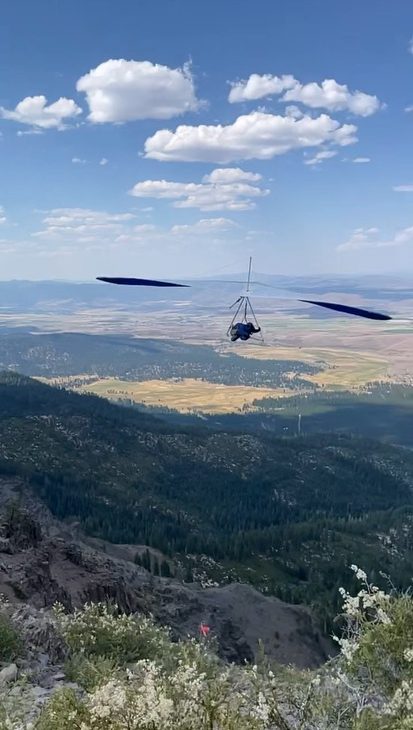
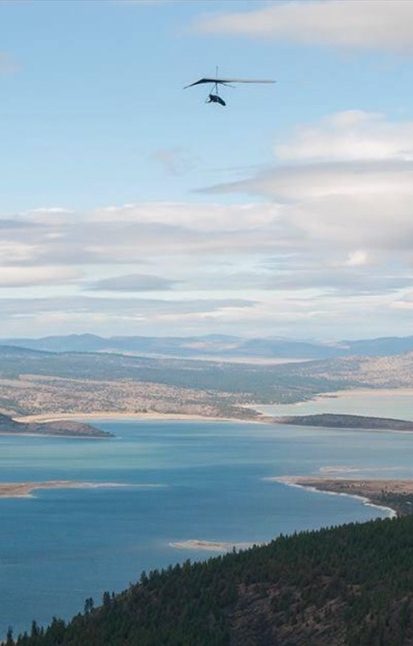
For example, “Indian Valley which lies above Greenville has a magnificent view of the valley,” notes Quam. “We can easily fly Keddie Ridge to the Dyer Mountain Lookout” that features scenic views of Lake Almanor, “and then fly back and land where you took off.”
Another awesome location that is world renowned is Hat Creek Rim in Shasta County, run by the Forest Service “and a great place for people to go who’ve gotten instruction and perhaps take their first few flights,” adding that, “It’s an easy place to soar, although landing takes some skill there.”
Additional popular areas Quam mentions include Gallatin Peak above Eagle Lake about 16 miles north of Susanville, a popular gathering place for hang glider pilots, as well as Thompson Peak, a recreational destination near the town of Janesville that caters to various activities including hiking, mountain biking, four-wheeling, and of course hang gliding. Both locations are in Lassen County.
“I’ve had flights above Eagle Lake where I flew with two adult eagles that were giving two juveniles flying lessons. … The entire time I was within a hundred yard proximity of them. But they didn’t seem at all bothered by my presence.”
At other times, “I’ve had birds like red-tailed hawks and falcons come and join me in flight.”
Quam notes that people envision jumping off a cliff when they hang glide, but in many cases like at Hat Creek the terrain is more of a gradual slope that pilots would run down before taking to the air. “It’s also predominately paragliders who utilize that site nowadays,” he adds.
The difference between paragliding and hang gliding is that hang glider equipment is more streamlined with an internal frame and is capable of much faster speeds, improved glide ratios, and the ability to fly in stronger conditions. A paraglider on the other hand doesn’t use a rigid structure for its wing, but due to their slower speed can typically land in much smaller fields.
Both hang gliders and paragliders do not have engines so once airborne a glider is constantly being pulled down toward the ground by gravity.
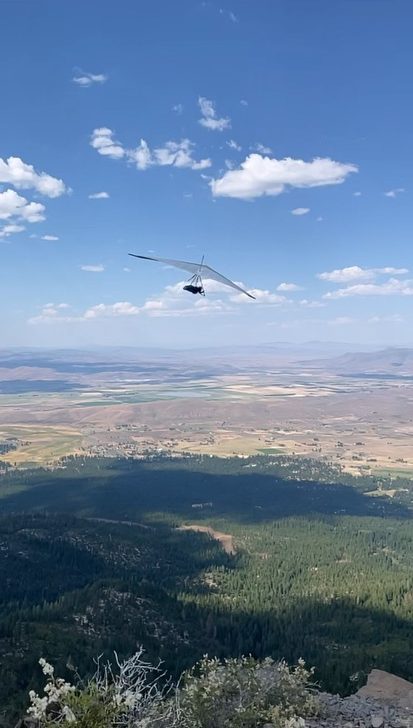
“The only way to combat this is to get the glider into air that is rising faster than the glider is descending.” The result will be that the pilot is able to gain altitude or at least maintain altitude, he says.
“There are two types of lift,” he continues. “The first is by circling the glider in thermals, which are columns of warm parcels of rising air.” The other is by launching the glider in a “ridge lift” which is created “when wind hits an obstruction like a mountain or hillside and gets deflected up the face of it,” but the amount of altitude possible in such cases is more limited.
As long as the glider stays in the upward moving air it will stay aloft, “but as soon as it flies out of the upward moving air, the glider will start to gently descend again.”
Quam says he has climbed as high as 13,000 feet or even higher riding a thermal and will typically stay aloft for up to two or more hours. Once he was high in the sky for close to six hours. In the summer a flight could cover several dozen miles.
He explains that “even on hot summer days when it’s 90 degrees you still have to wear a good warm jacket and gloves because the temperature drops toward freezing at those higher altitudes.”
Because the sport isn’t without risk, he says all pilots fly wearing a reserve parachute as a precaution in case of structural failure, a very rare event.
It is just as important he says knowing when not to fly when the weather isn’t suitable. “You need to check the forecast ahead of time for the right regional conditions before planning your flight,” which can change rapidly from day to day. “Sometimes you go to a spot and decide not to fly because of factors not in your control, like wind direction.”
Anyone starting out can either choose to buy new equipment in the neighborhood of $4,500 or find good condition used equipment for around $2,500, plus the cost of the harness ($1,000) and $700 for a parachute. “… Be sure to have equipment inspected by someone like a dealer who can make certain everything is in good shape.” Also needed is a good car roof rack system to transport your glider.
Hang gliding is essentially a safe sport, Quam insists, but you have to respect the laws of physics.
“As far as the technology has advanced, these kites almost fly themselves. … They want to fly perfectly.” In short, “Today’s modern day kite is a marvel of engineering.”
Instructors primarily live near urban areas. The time required for training varies appreciably depending on the student’s innate skills and with the type of training conditions.
Typically, though, a student will spend 5 – 10 lessons to obtain each of the first two USHPA pilot ratings (Beginner and Novice) – a process which generally takes from 3 to 6 months. The Internet can provide the names of instructors and contact numbers, and the localities they serve.
One does not have to be extraordinarily strong to hang glide, says Quam, and can be accomplished without great difficulty by either gender. He says that the ideal months to hang glide in the North State are from April through October.
He recommends that people always bring food and water to remote locations, as there won’t be any amenities available, even if you are just going along for the ride to observe the gliders from the ground.
“We’re lucky that we live in a hang gliding Mecca that attracts pilots from all around the world,” says Quam. “You end up meeting new people that love to fly and that can lead to new friendships as well.”
You forget about all the problems you may have in life he continues, “and just focus on the here and now,” enjoying the “extraordinary beauty that’s all around you and below you.”
He says that once you’ve flown, “You always walk outside with your eyes turned skyward” where you are “forever wishing to return.”
The experience of hang gliding is “indescribable” Quam enthuses, except to share that for him the experience has a “spiritual feel” whenever he’s soaring the heavenly realm.
“I remember my son Chase after his first soaring flight.” Quam recalls him saying, ‘Dad, that was like a dream.’ And I said yep, every time.”