
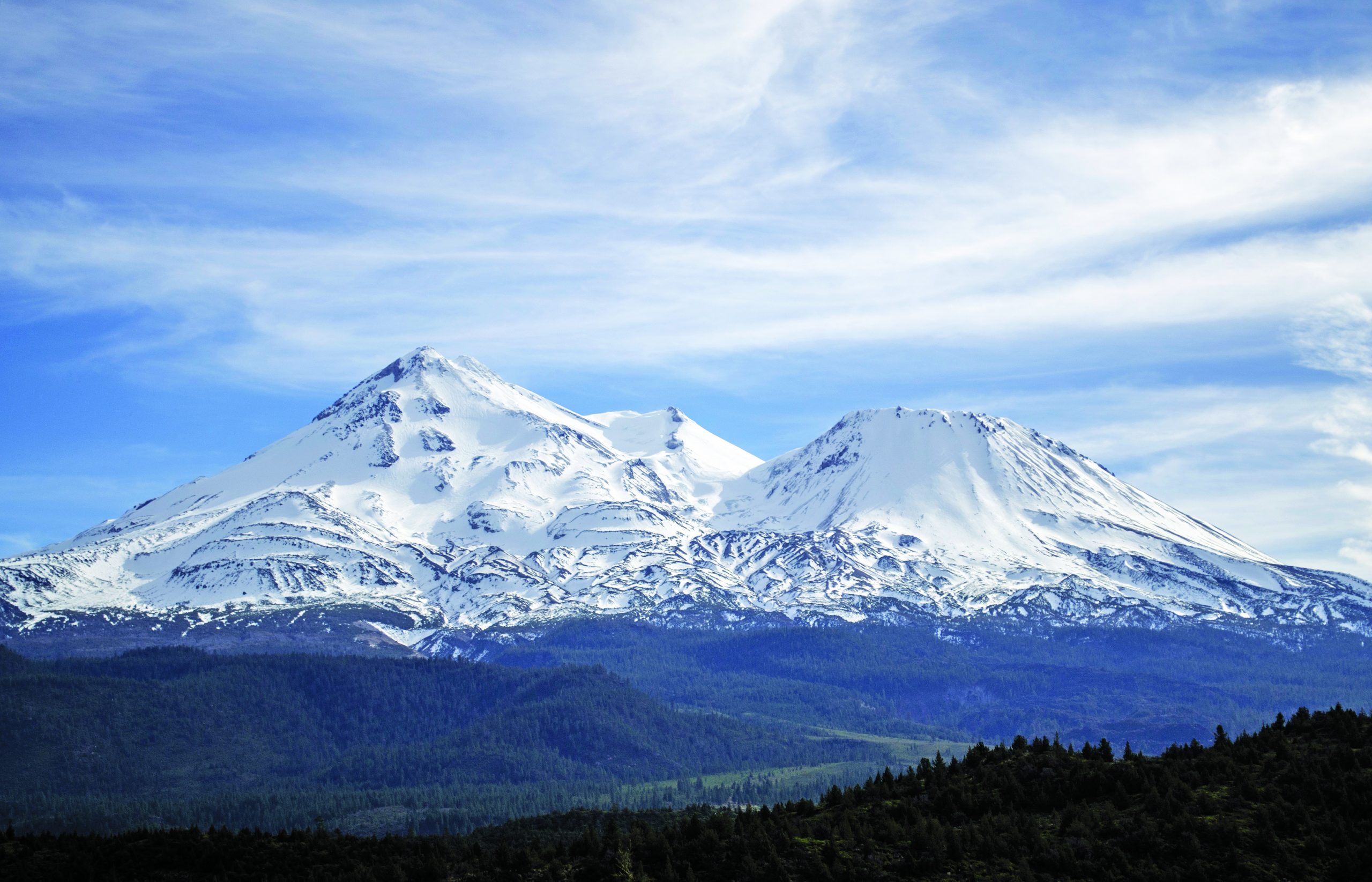
Story and Mt. Lassen Photo by by Stacy Fisher
The geology of Northern California is a subject of continuous fascination, with its varied and complex geologic history, mineralogical riches, and numerous mountain ranges — including simmering volcanoes.
Of the 161 potentially active volcanoes in the U.S., there are currently over 20 known in California, seven of which are thought to be the most energetic.
California is host to every type of volcano, comprising what geologists generally group into four main kinds — cinder cones, composite volcanoes, shield volcanoes, and lava domes.
The seven potentially active volcanoes most likely to erupt again include Medicine Lake Volcano, Mount Shasta, Mt. Lassen, Clear Lake Volcanic Field, Long Valley Volcanic Region, Coso Volcanic Field, and the Salton Buttes; all of which contain partially molten rock (magma) deep within their underground chambers.
Charles Watson, a registered professional geologist by trade, and president and Chief Geologist of Advanced Geologic Exploration in Chester, lists volcanology among his specialties.
Advanced Geologic is a full-service geological consulting firm that uses Watson’s broad experience in geology to provide precious metal exploration services, including evaluating gold claims and the techniques of recovery, as well as claim filing services.
As a geologist consultant for over 36 years, he maintains an active professional relationship with officials within the United States Geologic Survey (USGS), a scientific bureau within the Department of Interior.
Although just a handful of major volcanoes have been identified as currently dormant but potentially active, Watson notes there are several other less active volcanoes throughout the Cascade Range which have the potential to erupt but on a much smaller scale, such as Prospect Peak and Mt. Raker.
In fact, he assessed that, “there are more than 450 small volcanoes” throughout northern California that have produced “modest venting” over the millennia.
Watson admits that the classification of volcanoes as either dormant or active can be difficult to define. “The US Geologic Survey defines a dormant volcano as one that hasn’t had an eruption in three to four thousand years.”
But because volcanoes are sporadic in nature, “predicting when they’re going to erupt next is an inexact science.”
Notably, “Volcanoes don’t sneak up on you,” he states with a trace of whimsy, adding that it’s very rare that there’s a sudden, completely unexpected detonation that takes everybody by surprise.
The science of dating volcanoes and volcanic eruption time-scales is determined based on the use of radiometric dating, explains Watson, which is a method that calculates an age in years for geologic materials by measuring the presence of long-life radioactive isotopes plus its decay products, for example potassium-14/argon-40.
The rate of isotope decay is very consistent, and is unaffected by environmental changes, internal heat, atmospheric temperature, or even extreme pressure. This makes radiometric dating quite reliable.
One of Watson’s responsibilities is to write earthquake reports so that he can track the seismic activity of Lassen Peak and other volcanic fields for the general public and his fellow colleagues. “If there’s a hint that something unusual is going on, everybody is going to know about it.”
Medicine Lake Volcano
Medicine Lake Volcano is a large shield volcano in northeastern California about 30 miles northeast of Mount Shasta, according to Wikipedia. The volcano is located in a zone of east-west crustal extension east of the main axis of the Cascade Volcanic Arc and the Cascade Range.
The volcano, currently at an elevation of 7,921 feet and covers a total land area of 850-square-miles, has been active on and off over a time range of 500,000 years, resulting in relatively moderate eruptions coating the volcano’s sides with flow after flow of basaltic lava.
The most recent eruption was between 950 and 1,080 years ago forming Glass Mountain, with at least another nine explosive eruptions during the past 5,200 years.
Lava Beds National Monument covers two-thirds of the north flank of the volcano.
The Medicine Lake Highlands were formed when the center block collapsed along fracture lines, creating an enclosed basin or caldera, six miles long by four miles wide.
USGS reports that after exploratory drilling and geophysical studies a high temperature geothermal system below Medicine Lake volcano was revealed, fueled by a deeper zone of partially molten rock.
Medicine Lake derived its name from the Wahpeton Sioux using the Indian word MDE-WAKAN (meaning lake of the spirit), after a warrior overturned in his canoe and his body never recovered. The United States Geological Survey discloses that the first settlers shortened the name to Medicine Lake.
Due to its proximity to regional infrastructure, Medicine Lake Volcano has been designated a “high threat volcano” by the U.S. Geological Survey.
Mount Shasta
Mount Shasta in Siskiyou County is a majestic, ice-capped volcano in northern California and is the largest volcano of the Cascade Range. It is a complex stratovolcano composed of at least four overlapping volcanoes.
From the southwest, Shasta’s prominent west flank features an impressive lava dome, Shastina, climbing 12,330 feet, nearly two thousand feet below the height of the volcano’s summit at 14,180 feet above sea level.
Both Shastina and the summit Hotlum cone were formed during the Holocene, a time period covering the last 11,700 years of the Earth’s history — the time since the end of the last major glacial epoch, or “Ice Age.”
USGS scientists have found that Mount Shasta doesn’t erupt on a regular timescale. Research indicates that the volcano erupts episodically with ten or more eruptions occurring in short (500-2,000 year) time periods separated by long intervals (3,000-5,000 years) during which there are few or no eruptions.
The youngest dated eruption occurred 3,200 years ago. The blast produced block and ash flows on the volcano’s north flank.
Although considered an active volcano, earthquake activity has been low for the last few decades and ground deformation is negligible, indicating a low chance of an eruption in the foreseeable future.
Various legends say it’s home to a sacred spring, together with beings of the Netherworld who have transcended the physical plane, or by other accounts an underground crystal city full of ancient foes of Atlantis.
Known for its stunning natural beauty and outdoor recreational opportunities, Mount Shasta is a popular destination that draws outdoor enthusiasts and thrill seekers from around the world. Activities include hiking, mountain climbing, camping, biking, boating, fishing, and skiing; all outdoor adventures that are said to offer the experience of a lifetime.
Mt. Lassen
Lassen Peak (Mt. Lassen) is the southernmost volcano in the Cascade Range, which also includes potentially active Mt. Shasta located some 60 miles from Lassen Volcanic National Park.
It is the largest of a group of more than 30 volcanic vaults that has erupted over the past 300,000 years in northern California.
Mt. Lassen was born out of the ruins of Mount Tehama, a prehistoric volcano that last blew its top roughly 27,000 years ago when the mountain soared up to 12,000 feet high.
Watson describes Lassen Peak today rising 10,457 feet at its summit — as the largest shield-type volcano in North America.
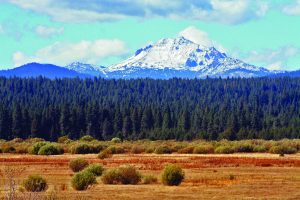
“The geological composition of Lassen Peak is rather complex. It has some characteristics that make it unique,” yet also shares common features with other volcanoes, he says.
The last significant eruption after a 27,000-year-long slumber occurred in May of 1914 when the peak was shaken by a steam explosion, with the largest blast on May 22, 1915, the most violent in thousands of years, sending ash and steam six miles into the sky with tremendous force. Then continuing with a series of less significant blasts until 1917. A short pause followed with a small final eruption in 1921.
Searing volcanic gas laden with ash swept down the flanks of Mt. Lassen volcano as a pyroclastic flow, according to news reports at the time.
Volcanic ash is made up of very fine particles that billow upward together with super-heated steam, forming an eruption column that can attain stratospheric heights.
The ballistics of the eruption typically sends large chunks of solid rock and molten lava crashing down around the vent. During especially powerful eruptions, rock may be flung as far as 12 miles away from the vent of the volcano.
Ash in the eruption cloud, carried by the prevailing winds, remain suspended for hundreds of miles before settling to the ground as ash fall over a number of days and weeks.
Volcanic eruptions typically eject huge quantities of aerosols composed of sulfur dioxide gas that reacts with water in the atmosphere to form sulfuric acid, and can stay in the stratosphere for up to three years, moved around by winds and may cause significant cooling worldwide.
Clear Lake Volcanic Field
Based on information published in Wikipedia, the Clear Lake Volcanic Field is located beside Clear Lake in California’s northern Coast Ranges. The site was particularly active during the Late Pliocene (≈ 2.6 million years ago) to early Holocene period, the current geological epoch beginning approximately 11,700 years ago.
Clear Lake Volcanic Field is the northernmost and youngest field in a chain of volcanic fields in the California Coast Range. It has not erupted for several millennia; the last being about 11,000 years ago.
The field consists of lava domes, cinder cones, with eruptive products varying from basalt to rhyolite (silica-rich volcanic rock).
Sporadic volcanic-type earthquakes continue to occur, together with numerous hot springs along with volcanic gases seeping through fissures at the surface called fumaroles — pointing to the potential of another eruption again at some future date, although predicting the timing of any eruption is difficult if not impossible.
Cobb Mountain and Mount Konocti are the two highest peaks in the volcanic field, at 4,724 feet and 4,285 feet, respectively.
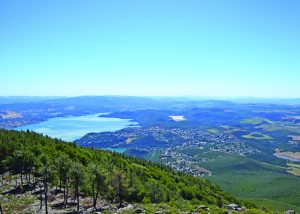
USGS says the most likely type of eruption that could occur in the Clear Lake Volcanic Field is a “phreatomagmatic eruption” close to or beneath the east arm of Clear Lake. Such eruptions are explosive, and would pose ballistic and ash-fall hazards to the lakeshore and to areas within a few miles of the central event.
Erosion over countless millennia has produced a leveling of the landscape, hiding the volcano beneath the ground that overlays it from above.
The magma chamber beneath the field also powers a hydrothermal field called The Geysers, which hosts the largest complex of geothermal power plants in the world.
Long Valley Volcanic Region
One of the largest supervolcanoes in the world, the Long Valley Caldera and the Mono-Inyo Craters chain, measuring 20 miles long by 11 miles wide, form a vast volcanic complex in eastern California, adjacent to Mammoth Mountain.
It consists of a broad depression of land east of the Sierra Nevada roughly 40 miles east of Yosemite Valley, and 200 miles east of San Francisco.
A super powerful eruption last occurred at Long Valley more than 700,000 years ago.
Lying dormant for the past several thousand years, persistent earthquake activity and ground uplift in recent decades have been recorded by geologists using seismographs to monitor the supervolcano, sparking some concern.
Earthquakes can be associated with an impending eruption, Watson restates. “We know that a strong quake can trigger volcanic activity by allowing for magma to push up toward the surface” through cracks.
Experts at the USGS emphasize that underground activity absolutely doesn’t mean there is any imminent danger, despite uncovering evidence that there are 240 cubic miles of magma sitting beneath the region.
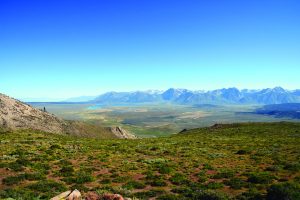
Some geo-specialists suspect the Long Valley Caldera as a volcano is moribund and the increased seismic activity is being generated by still hot magma cooling and solidifying.
Watson says common precursory indicators of volcanic activity include not only increased seismicity, but also ground deformation, and variations in the nature and rate of gas emissions.
Volcanism in the Long Valley region began 4 million years ago following the uplift of the Sierra Nevada Mountains.
Wikipedia publishes that nearby Mammoth Mountain is a “lava dome complex west of the structural rim of the Long Valley Caldera,” consisting of domes formed in a long series of eruptions from 110,000 to 57,000 years ago, “building a volcano that reached 11,059 ft. in elevation.”
Watson remarks that, “Long Valley is not above a hotspot, such as those which fuel the Yellowstone Caldera or the volcanoes of Hawaii.” The tectonic causes of the volcano are still largely unexplained and are therefore a matter of much ongoing research.
The caldera has an extensive hydrothermal system. Casa Diablo Hot Springs at the base of the resurgent dome also hosts a geothermal power plant. Other hot springs in the area are open to bathers.
The largest tourist attraction in the caldera is the Mammoth Mountain Ski Area: the area offers skiing and snowboarding in the winter, and mountain biking in the summer. The Hot Creek tourist attraction was closed to swimming in 2006 due to increased geothermal activity.
In 1982, the United States Geological Survey under the Volcano Hazards Program began an intensive effort to monitor and study geologic unrest in Long Valley Caldera.
Researchers say the goal is to provide residents and civil authorities with reliable information on the nature of the potential hazards posed by this unrest and to provide a timely warning of an impending volcanic eruption.
Coso Volcanic Field
At an elevation of 7,874-feet the Coso Volcanic Field is located in Inyo County, at the western edge of the Basin and Range geologic province and northern region of the Mojave Desert; 100 miles northeast of Bakersfield, mainly within the boundary of the Naval Air Weapons Station, China Lake.
The volcanic geothermal resource fuels a number of hot springs, steam vents, and boiling mud pots near the center of the Volcanic Field.
Volcanism began in the Coso Volcanic Field approximately six million years ago, with the most volcanically active period occurring during the Pliocene between about 4 and 2.5 million years ago.
The third period of activity occurred during the Pleistocene, the geological epoch that lasted from 2.58 million ago to the Earth’s most recent period of repeated glaciations.
The region is most well known for nearly 40 foot high-silica domes and lava flows that erupted during this time period.
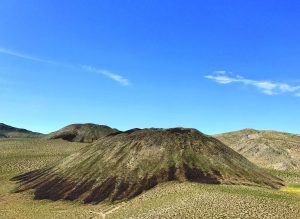
This most recent eruption formed the Volcano Peak basaltic cinder cone and lava flow some 39,000 years ago. There are some clues however that flow activity occurred as recently as 12,000 years ago.
According to the USGS, over the last quarter million years a total of about 40 eruptions have produced a field of steep-sided lava domes, red hills of volcanic cinder, and rough-surfaced lava fields.
The U.S. Navy monitors earthquake and geothermal activity within the Coso Volcanic Field and reports its findings on a recurring basis.
Salton Buttes
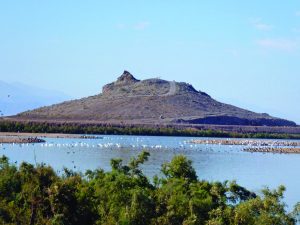
The USGS locates Salton Buttes volcano complex within the Salton Sea Geothermal Field located about 90 miles southeast of Palm Springs in Imperial Valley.
Using radiometric dating such as the potassium-argon method, the first eruptions are known to have occurred approximately 400,000 years ago, followed by a long lull in volcanic activity until around 18,000 years ago, with the most recent eruption about 1,800 years ago. That eruption started explosively, says USGS. Over time it progressed to a relatively gentle progression of several glassy-looking obsidian lava domes.
The Salton Sea Geothermal Field associated with the volcano currently produces enough power to supply about 325,000 homes.
When Will They Next Erupt?
“Particularly vigorous active steam vent explosions often accompany the onset of a volcanic eruption,” Watson explains, “including the formation of hot springs and bubbling pools of boiling mud.”
Although volcanic eruptions like those that occur on the seven examples listed are by their nature unpredictable. “There are signs to look for that may suggest an eruption is imminent,” pointing out that, “Volcanic eruptions are preceded and accompanied by geophysical and geochemical changes in the volcanic system.”
Because the earth’s crust under these volcanoes is relatively thin, “it allows hot magma to more easily rise to the surface.” That’s why he thinks, “Just one strong earthquake could be the trigger,” for another major eruption.
The United States Geological Survey acknowledges on its website page that “the potential for damaging earthquakes, floods, landslides, and wildfires is broadly recognized in California,” but by the same token, “The same cannot be said for volcanic eruptions, despite the fact that they occur in the state about as frequently as the largest earthquakes on the San Andreas Fault. … At least ten major eruptions have taken place in the past 1,000 years” in the US, “and future volcanic eruptions are inevitable.”
No one can say when, but it is almost certain that these volcanoes will one day experience major eruptions again — and again.