
Some links in this article are Amazon affiliate links. As an Amazon Associate, I earn from qualifying purchases. If you choose to buy through these links, I may receive a small commission at no extra cost to you.
On a winter evening in the mountains, there are few sounds more familiar than the steady hum of a heater working against the cold. Snow settles quietly against the windows, the wind finds the smallest gap near the front door, and somewhere in the garage an old refrigerator clicks on again. It all feels normal—until the utility bill arrives.
Years ago, humorist Will Rogers famously observed, “Buy land. They aren’t making any more of the stuff.” The same could be said for inexpensive energy. The days of predictable, low utility costs seem to be slipping further into the past, especially for those of us who trade city convenience for clean mountain air and a little elbow room.
If you’ve chosen rural living, you already understand trade-offs. We give up the corner store open at midnight, but we gain star-filled skies and the scent of pine after a summer rain. Energy works much the same way. Longer power lines, colder winters, hotter afternoons, and aging appliances all play their part in what shows up on that monthly statement.
The good news is that learning how to increase home energy efficiency does not require turning your home into a science project or disconnecting from the grid. In most cases, it starts with simple observations, a few thoughtful upgrades, and a better understanding of where your energy is actually going.
Before investing in solar panels or major renovations, it helps to ask a straightforward question: what, exactly, is using the most electricity in your home?
How to Increase Home Energy Efficiency by Reducing Energy Waste
Before making improvements, it helps to understand where the power is actually going. In most homes, the answer is not mysterious. Heating and cooling systems typically use more electricity than anything else—often close to half of total household energy use. When winter settles in or summer heat lingers for weeks, your HVAC system works steadily in the background, keeping things comfortable while the meter outside keeps spinning.
After heating and cooling, water heaters are usually next in line. Every hot shower, load of laundry, and sink full of dishes draws from that tank. Electric water heaters, in particular, can consume a surprising amount of energy over time.
Then there are the quiet, constant users. Refrigerators and freezers cycle on and off all day and night. An older unit in the garage—especially one built decades ago—can draw two or three times the electricity of a modern replacement. Clothes dryers, electric ovens, and space heaters also make their presence known when the bill arrives.
It is rarely one dramatic energy leak that drives costs upward. More often, it is a combination of steady background use and small inefficiencies that add up over months and seasons.
The encouraging part is this: once you know what burns the most energy in your home, you can begin making targeted improvements instead of guessing. And that process starts with something most of us already have on the kitchen counter or tucked into a desk drawer.
Your utility bill.
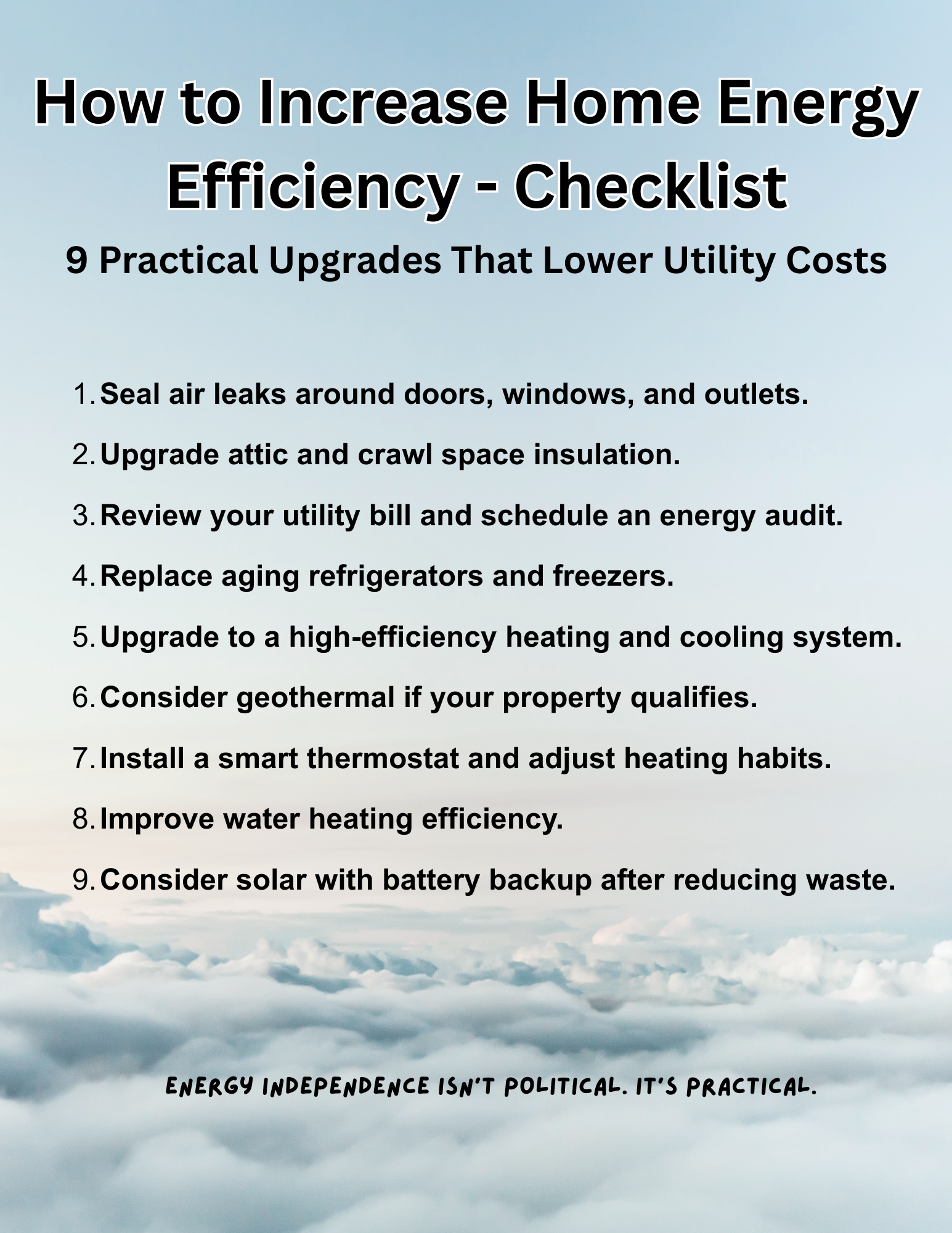
Click the image to download the checklist.
How to Increase Home Energy Efficiency by Understanding Your Utility Bill
If you are serious about learning how to increase home energy efficiency, the best place to start is not in the attic or on the roof. It is at the kitchen table with your utility bill.
For many of us, that bill reads like a foreign language. Kilowatt hours, tiered rates, delivery charges — it can feel like you need a Rosetta Stone just to translate what happened last month. (Is a kilowatt hour a measurement or a variety show sponsored by the power company?)
Instead of focusing on the total due, look at your usage over time. Most utilities provide twelve months of history. Notice when the spikes occur. Do your numbers climb sharply in January and February? That points to heating. Do they jump in July and August? Cooling may be working harder than you think.
This is also the time to take inventory inside your home. How old is the refrigerator humming in the garage? When was the last time the water heater was inspected? Are you relying on electric resistance heaters in rooms that never quite feel warm?
Many local providers, including Pacific Gas and Electric Company, Lassen Municipal Utility District, and Plumas-Sierra Rural Electric Cooperative, offer energy audits or usage tools that help break this information down in plain terms. These programs are designed to help homeowners make informed decisions before investing in upgrades.
Once you understand where your energy is going, the path forward becomes clearer. Efficiency is not about replacing everything at once. It is about addressing the areas that quietly cost the most month after month.
And that is where practical upgrades begin.
1. Seal Air Leaks Around Doors and Windows
If you have ever felt a faint whistle of wind near the front door on a cold evening, you already understand how small gaps can become expensive.
Warm air does not stay put simply because we would like it to. It slips through cracked weatherstripping, loose window frames, attic penetrations, and even electrical outlets along exterior walls. In summer, cooled air escapes just as easily. Over time, those small losses force your heating and cooling system to run longer than necessary.
Sealing air leaks is one of the simplest ways to increase home energy efficiency. Fresh weatherstripping, door sweeps, caulking around window frames, and foam gaskets behind outlets can make a noticeable difference. These improvements are modest in cost, straightforward to install, and often deliver immediate savings.
Before replacing appliances or installing new systems, it makes sense to stop paying to heat or cool the outdoors.
2. Improve Attic and Crawl Space Insulation
Heat has a mind of its own. It rises in winter and pushes inward in summer. Without proper insulation, your home becomes a place where conditioned air constantly trades places with whatever is happening outside.
In many older homes, attic insulation has settled, thinned, or never met modern standards to begin with. Crawl spaces and rim joists are often overlooked entirely. Yet these areas play a significant role in how efficiently your home holds temperature.
Adding or upgrading insulation is not glamorous work, but it is one of the most effective long-term strategies for increasing home energy efficiency. A properly insulated attic reduces the load on your furnace or heat pump. Floors feel warmer in winter. Rooms maintain steadier temperatures year-round.
It is not unusual for homeowners to notice comfort improvements long before they see the full financial impact on their bills.
3. Replace Aging Refrigerators and Freezers
Some appliances become part of the family. They hum faithfully for decades and ask for little in return. But older refrigerators and freezers can quietly consume far more electricity than modern models.
If you are still running a vintage “June Cleaver” era unit in the kitchen — or an old freezer in the garage — it may be time to take a closer look. Appliances built twenty or thirty years ago often use 2 to 3 times as much electricity as today’s high-efficiency replacements.
Upgrading to an Energy Star-rated refrigerator does more than reduce consumption. It lowers the steady background demand that runs day and night. Unlike seasonal heating spikes, this is a year-round savings opportunity.
Sometimes, increasing home energy efficiency is not about a dramatic change. It is about retiring equipment that has simply done its time.
Work With Your Local Utility — Not Against It
Increasing home energy efficiency does not mean disconnecting from the grid. In many cases, your local utility provider can be one of your best resources.
Here in Northern California, homeowners are typically served by one of three providers. Each offers tools, rebates, and guidance that can make efficiency upgrades more affordable.
Pacific Gas and Electric Company (PG&E)
PG&E offers residential rebates for heat pumps, water heaters, insulation upgrades, and energy-efficient appliances. They also provide online tools that allow customers to track usage patterns and compare seasonal consumption.
Click Here to explore current residential rebate programs and efficiency tools directly.
Before purchasing major equipment, it is worth checking which upgrades qualify for incentives.
Lassen Municipal Utility District (LMUD)
LMUD has long supported energy-efficient construction and retrofits through its SmartBuilt Home and efficiency programs. As a local municipal provider, LMUD often publishes rebate details and program updates tailored specifically to Lassen County homeowners.
Click Here for current programs and contact information.
Because municipal utilities differ from investor-owned utilities, rate structures and incentives may vary — so reviewing their latest information is wise before starting a project.
Plumas-Sierra Rural Electric Cooperative (PSREC)

Download FREE DIY Energy Audit
As a member-owned cooperative, PSREC provides efficiency programs, net metering options, and information on renewable integration for its service area. Cooperative members may also have access to consultations and financing guidance for larger upgrades.
Click here for current programs
Programs change over time, and eligibility requirements can shift. Checking directly with your provider ensures you are working with the most current information.
Efficiency upgrades are easier to justify when rebates and incentives reduce the upfront cost — and partnering with your local utility keeps the process straightforward.
4. Upgrade to a High-Efficiency Heating and Cooling System
If heating and cooling account for the largest share of household energy use — and in most homes they do — then this is where meaningful gains can be made.
Older furnaces and air conditioners work hard but often inefficiently. Systems installed twenty years ago were built to different standards than those available today. Even a well-maintained unit can lose performance over time, running longer cycles to achieve the same result.
Modern high-efficiency furnaces and heat pumps are designed to deliver more consistent temperatures while using less energy. Variable-speed motors adjust their output rather than cycling fully on and off. That steady operation improves comfort and reduces waste.
For homeowners looking to increase home energy efficiency, upgrading HVAC equipment is often one of the most substantial improvements available — though it is also one of the larger investments. That is why it makes sense to address air leaks and insulation first. A tighter, better-insulated home allows any new system to perform at its best.
And then there is geothermal.
5. Consider Geothermal Heating and Cooling
I first learned the basic principle of geothermal efficiency from a black Labrador named Stumpy. On summer afternoons when temperatures crept past the century mark, Stumpy would dig a shallow hollow near the rose bushes and settle into the cool earth. He understood something instinctively: a few feet below the surface, the ground resists extreme temperature swings.
Geothermal systems apply the same principle. A network of underground pipes circulates fluid through stable earth temperatures, transferring heat into the home during winter and drawing excess warmth away in summer. Because the ground temperature remains relatively constant, the system works with nature rather than against it.
Geothermal installation requires adequate land and a higher upfront investment. But for properties that qualify, the long-term efficiency and stability can be significant. Operating costs are typically lower than those of traditional systems, and the equipment lifespan is often longer.
It is not the right solution for every home. But for some rural properties, it can be a steady and dependable option — without a pile of dirt on the patio.
6. Install a Smart Thermostat and Adjust Heating Habits
A heating system can only work with the instructions it receives.
One of the most common questions homeowners ask is whether it is cheaper to leave the heat on low all day or to lower it when no one is home. In most situations, reducing the thermostat setting while you are away and bringing the temperature back up when needed uses less energy than maintaining the same temperature around the clock. Heat naturally escapes from a home when it is colder outside. The larger the temperature difference, the faster that loss occurs.
A smart thermostat helps manage that difference without constant attention. These devices allow you to program setbacks, track usage patterns, and adjust temperatures remotely. Instead of heating an empty house all afternoon, the system can begin warming the space shortly before you return.
The result is not only lower consumption but steadier comfort. And when paired with proper insulation and sealing, those adjustments can noticeably increase home energy efficiency without replacing major equipment.
7. Improve Water Heating Efficiency
After heating and cooling, water heating is often the next largest energy user in a home. Showers, laundry, and dishwashing quietly draw energy every day.
Several practical improvements can make a difference. Insulating hot water pipes reduces heat loss as water travels through the home. Lowering the thermostat on the water heater slightly — while staying within safe temperature guidelines — can cut consumption. Replacing an aging electric resistance water heater with a heat pump water heater can significantly reduce operating costs over time.
Unlike seasonal heating spikes, water heating expenses are consistent year-round. That makes efficiency improvements in this area especially valuable.
8. Upgrade Lighting and Eliminate Phantom Loads
Many homeowners have already replaced incandescent bulbs with compact fluorescents or LEDs, but older fixtures and specialty bulbs often remain. Modern LED lighting uses a fraction of the electricity of older bulbs and lasts far longer.
Beyond lighting, there are devices that quietly draw power even when not in use. Televisions, game consoles, chargers, and small appliances can continue consuming electricity in standby mode. These “phantom loads” may seem insignificant individually, but together they add up over months.
Using power strips to fully disconnect electronics when not in use is a simple habit that can increase home energy efficiency without any renovation.
9. Consider Solar With Battery Backup — After Improving Efficiency
Solar panels have become a familiar sight across rural landscapes and suburban rooftops alike. For many homeowners, they represent a way to stabilize long-term energy expenses and add resilience during outages.
However, solar works best after a home has addressed its primary inefficiencies. Generating electricity is valuable, but reducing demand first ensures that any installed system is sized appropriately and operates efficiently.
Battery storage adds another layer of stability by providing backup power during outages or peak rate periods. For properties served by providers such as Pacific Gas and Electric Company, Lassen Municipal Utility District, or Plumas-Sierra Rural Electric Cooperative, interconnection policies and net-metering programs vary, so reviewing current guidelines is essential before making a decision.
Solar is not required to increase home energy efficiency. But when combined with smart upgrades and reduced waste, it can provide long-term predictability.
Efficiency Is About Stability
There was a time when most of us gave little thought to how energy moved through our homes. The heater came on. The lights worked. The refrigerator hummed along in the background. Comfort felt automatic.
Today, utility bills tend to get more attention.
Learning how to increase home energy efficiency is not about chasing trends or making dramatic changes overnight. It is about understanding where energy is used, reducing waste that quietly escapes, and making thoughtful upgrades that protect both comfort and the budget.
For rural homeowners especially, efficiency offers something valuable beyond savings. It provides stability. A well-insulated home with modern equipment is less vulnerable to seasonal swings. A right-sized heating system runs more steadily. A carefully considered solar system or battery backup adds resilience when weather or infrastructure falters.
None of these steps requires disconnecting from the grid or turning your home into an experiment. They simply require paying attention.
When humorist Will Rogers remarked that they were not making any more land, he was speaking about scarcity. Energy works much the same way. While technology evolves, efficiency remains a constant advantage.
Energy independence is not political. It is practical.
And for homeowners willing to make a few steady improvements, it is well within reach.