
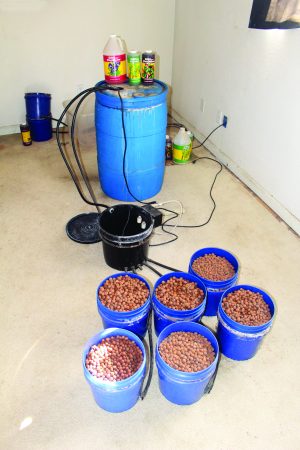
A large, 30-gallon capacity storage barrel is the heart of your ‘ebb and flow’ hydroponic system, where a mixture of water and liquid fertilizer is transported through a hose to your grow buckets in 15 to 30 minute intervals. Photo by Stacy Fisher
Growing Veggies With Hydroponics
By Stacy Fisher
Hydroponic Gardens for Home Grown Veggies
Story and photos by Stacy Fisher
With inflation still high, some people are seriously considering installing an indoor hydroponic garden to contribute an additional household food source.
When you grow your own, your food just seems to taste better because it’s fresher, while providing families with a year-round supply of additional sustenance to supplement their groceries and provide some relief to the family budget.
The benefits of such a do-it-yourself project rests not only in the money you’ll save in groceries from your local market, but in the satisfaction you’ll feel growing your own vegetables, herbs, or assorted fruit, some of which you may wish to sell for extra cash or to share with friends, depending on the size of your operation.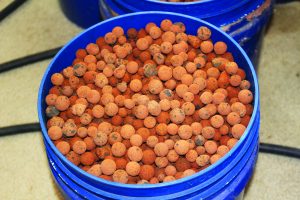
Experts point out that hydroponically grown food is more nutritious because your indoor garden-fresh produce doesn’t have to be shipped over several days to a distant location. There’s no need for pesticides or weed killer either. Plus animals can’t get to your foodstuff the way they can in an exposed outdoor garden setting.
The use of a traditional dirt medium isn’t required for growing plants hydroponically, and instead growers use a nutrient rich water solution that circulates through plastic buckets. The buckets are filled with small, fired clay balls — such as Hydrocorn. This permits the roots to anchor themselves between the small spaces between the clay balls and utilize nutrients from the fertilized-infused water efficiently.
Other non-traditional techniques of growing your own food involve suspending your plants in mid-air (aeroponics). The grower sprays the root system frequently to provide nourishment to the roots. Drip systems also have their own benefits and have become more widespread in recent years.
The optimum size of your outdoor growers shed, assembled greenhouse, or converted interior room depends on the kind of hydroponic design you’re constructing and your personal requirements. The type and number of plantings will determine how much space is needed that will be part of your calculations.
Commercially made set-ups from stores specializing in hydro-garden products or from online suppliers can be purchased, or build your own inexpensive hydroponic system using easily purchased components to customize your operation.
A large, 30-gallon capacity storage barrel is the heart of your ‘ebb and flow’ hydroponic system, where a mixture of water and liquid fertilizer is transported through a hose to your grow buckets in 15 to 30 minute intervals.
Water is continuously recycled from the large storage barrel connected by a hose to the plastic control bucket regulated by a timer. Additional segmented tubes from the control bucket attach to your grow buckets to complete the line.
Numerous designs use submersible pumps to circulate water carrying the nutrient-rich solution from the reservoir to nourish the roots of the plants. (Such pumps can easily be found at hydroponic supply stores). Choose one that can be cleaned regularly or includes a filter that can be easily replaced when depleted.
Automatic draining of the plastic grow buckets allow the roots to breath and prevents the growing plants from drowning.
In order to grow indoors, an artificial light source designed to emit a color spectrum that simulates natural sunlight is essential to allow plants to undergo photosynthesis.
Fluorescent grow bulbs, incandescent, or more powerful metal halide lights are available that can do the job. Bulb wattage between 600-1,000 watts with a dedicated timer turns on and off the light(s) according to a specific schedule that changes over time. Different plants have various light requirements. For proper growth, each species of plant needs to be illuminated an appropriate length of time.
Best of all, if your hydroponic garden is constructed in an open outdoor space, natural sunlight is ideal and completely free.
However, outdoor growing may require pesticides, adding extra cost to your system. Furthermore a barrier must be erected, particularly in rural areas to prevent animals such as deer or raccoons from snacking on your plants and undermining your efforts.
Depending on the amount of light available in your region, a greenhouse may benefit from additional artificial lighting as well. This is particularly true in northern latitudes where not enough natural sunlight to grow your vegetables or fruit is accessible during certain times of the year.
The downside to growing outdoors is that changing weather conditions and erratic temperature variations can limit your growing season resulting in less than ideal results. You’ll need to check regularly that the environment inside your greenhouse remains stable.
An electrical outlet located close by to your outdoor site is also indispensable in order to provide electricity for the lights inside your greenhouse, plus in cold climates a heater along with a dehumidifier is essential during winter months to keep plants from freezing or becoming moldy.
Temperatures between 70 and 80 degrees Fahrenheit are optimum for many varieties of food plants; humidity should be maintained at less than 50 percent. To keep track, a temperature gauge provides a constant readout.
Fertilizing compounds in varying ratios of nitrogen, potassium, magnesium, phosphorus and other elements mixed in water are used depending on the different needs of the species of plants being grown. The ratios of these compounds will likely vary during the growing process.
It wouldn’t be worthwhile if you couldn’t grow your vegetables economically, and that’s why the use of advanced hydroponics can be cheaper in the long term than most produce you can buy at the store — with some notable exceptions.
Start-up costs can be high, however, as it can be somewhat expensive to procure the components needed to start your garden project; although you may find used but perfectly serviceable equipment from those who have discontinued their hydroponic endeavors and are willing to sell their equipment at a fraction of the original cost.
You Tube videos and online sites are great resources offering valuable tips, and provide examples of a number of configurations that match your budget and available space.
You may even find people in your community who already have such systems in place and are happy to assist you in setting up your own.
Call or better yet visit any local nursery or garden store that specializes in ready-made hydroponic kits or for information on what is necessary to establish your soilless garden. Once everything is in place, start growing. When it’s time to harvest prepare your family to feast on the freshest fruits and vegetables they’ve ever tasted!
Sidebar:
Garden and Hydroponic Suppliers:
Northern Roots Indoor Garden and Hydroponics Supply, 4580 Westside Rd, Redding, CA 96001, (530) 244-7891
The Grow Shop, 1030 E 4th St, Reno, NV 89512, (775) 501-5633
Milwood Florist & Nursery, 2020 Main St., Susanville, (530)257-9194
Sierra-Cascade Nursery, 472-715 Johnson Rd., Susanville, (530) 254-6883.
Country Gardens, Standish, 721-425 Capezzoli Ln, Standish, CA 96128, (530) 260-1437.
Greenfire Hydrogarden & Organic Supply, 2725 State Hwy 32, Ste A, Chico, (530) 895-8301.
Amazon Garden Supply, 521 Cal Oak Rd, Oroville, CA 95965, Phone: (530) 534-4769.
Bare Roots Hydroponic & Organic, 9626 Tanqueray Ct, Redding, 96003, (530) 223-1000.
Reno Hydroponics, 5635 Riggins Court #21, Reno, NV, (775) 284-8700.
Every Bloomin’ Thing, 705-670 US Highway 395 E, Susanville, (530) 251-2330.