Article and Photos By Jim Moore
Within the forests of the Mountain Meadows Basin in Lassen County, there is a small sloped meadow of about four acres in size. It is one of my favorites, visited often with my kids. We called the meadow “Lizardo Meadow” after a rather large feisty alligator lizard we once saw there. This meadow is a very ‘wet’ meadow in the springtime which slowly transitions to a dry meadow towards the later summer months. Occasionally we would see some Canadian Geese grazing in the meadow which is dominated more with grasses than with wildflowers. Usually I visit this meadow in mid-summer or later in the fall; but decided a while back to visit in early April soon after the snows had melted away. Upon entering the meadow at the same place as always I immediately came upon a patch of scattered Great Basin Violets, a species of wildflower that I had not seen there on previous visits. As seen in the photos these violets are very pretty, and really stood out, since most of the meadow was not yet fully green and regrown.
My online research on the Great Basin Violet (species Viola beckwithii) did reveal that it is a very early perennial bloomer whose flowers often fade away before the coming of warmer weather, and before the pollenating insects emerge. As such, it is not uncommon for the showy flowers to produce no seed. However, cool weather violet species often have other hidden non-opening self-pollenating ‘petal-less’ flowers down low near the base of the plant, that do not need pollinators for successful seed production. This type of seed production is called ‘cleistogamy’ meaning: ‘closed-marriage seed production, while the seed production via the pretty flowers is called ‘chasmogamy’ meaning: ‘openmarriage’ production. I am always learning something wonderfully new like this as I research our amazing NorCal wildflowers! The seed of the self-
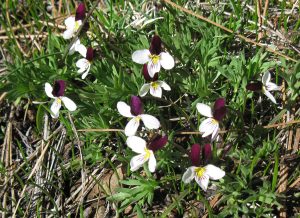
pollenated petal-less flowers produce plants with flowers very similar in color-patterns to the parent plant; whereas the seed of flowers cross pollenated by insects may produce much variation in color patterns. Anyone who has Johnny-jump-up violets (species Viola tricolor) growing in their yards will know this to be true indeed. The flowers of crosspollenated Great Basin Violets, especially the lower three petals, may vary from white to violet, or even to dark purple-maroon like the upper petals. All the violet plants seen in Lizardo Meadow were colored as shown in the photos.
The Great Basin violet is primarily a high elevation Northern Great Basin species, but is also found in the nearby Northeastern Sierras and Cascade Mountains. Its primary habitat is moist places within shrub and pine habitats, and also within moist springtime sagebrush habitats. Other common names are: Sagebrush Pansy, Western Pansy Violet, and Beckwith’s Violet so named in honor of Florence Beckwith, a well known early botanist who collected many plant specimens from Colorado, California, New Jersey, and New York. Seed dispersal is ballistic (exploding seed capsules), and by foraging ants. One thing that I learned about violets and ants is that some violet species have a mutualistic relationship with certain species of ants, called myrmecochory: meaning dispersion-by-ants, where the ecological interaction between the violet species and the ant species benefits both. The seed of certain violets species are produced with a small attached fleshy structure called an elaiosome which is rich in lipids and proteins, which are attractive to certain ants. The violet seeds are taken to the nest colony and the elaiosome is removed and fed to the ant larva. The seed itself is usually discarded in underground ant dumps, called middens, or ejected from the nest in above ground dumps; and yes, some ants do have dumps for their trash and waste products! The seed in these middens are thus hidden from the many seed eating critters, and when they germinate they benefit from a well fertilized substrate! I could not find any information to verify whether myrmecochory benefits Great Basin Violets. I suppose I should visit Lizardo Meadow more often to find seed pods before they go ballistic, to see if the seeds have attached elaiosomes. For that matter, I should probably also do the same with the scores of invasive Johnny-jump-ups in my yard!