
By Stacy Fisher
“Busy as a bee” is a common refrain said about anyone who diligently works long hours at a given task.
It’s not surprising that any industrious activity is so often related to a colony of bees, which consists of workers tirelessly constructing their hives and serving their queen.
Dr. Elina Lastro Niño, Entomologist and Associate Professor of Cooperative Extension – Apiculture Department of Entomology and Nematology – UC Davis is an expert on pollinators, especially honey bees.
“My research is designed to address immediate needs of various agriculture stakeholders” by advancing approaches to “understanding and improving honey bee health,” and particularly during pollination, she adds.
Honeybees and pollinators in general are under environmental threat from a number of different adversaries, she remarks. For example, varroa mites that feed on the fat of both adult bees and developing bees, reducing the fat storage they need to survive. This can lead to the death of a honeybee colony. “If you talk to beekeepers it is a big problem that they have to constantly manage.”
Her ongoing research projects include the evaluation of novel “biopesticides” for effectiveness against varroa mite infestation, and evaluating orchard management practices with a goal of improving the environment for honeybees.
Biopesticides are derived from several species of plants, she says, but are still under investigation for efficacy and safety for pollinators as well as other animals and people.
Dr. Niño says it has been a challenge identifying which plants are best for that purpose. “We’ll see really good effectiveness in the laboratory but in the field we don’t see the same results.”
Bees and other pollinators are essential because they contribute to the propagation of a number of different plants.
The USDA discloses that “… between 75 percent and 95 percent of all flowering plants on the earth need help with pollination – they need pollinators… Pollinators provide pollination services to over 180,000 different plant species and more than 1,200 crops.”
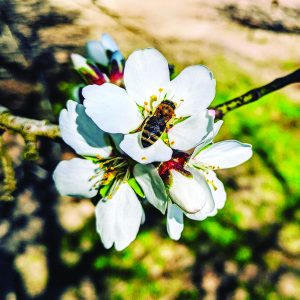
Honey bees alone pollinate 50 percent of agricultural crops worldwide, including 80 percent of all flowering plants, and more than 130 types of fruits and vegetables, according to Farmers.gov. Entomologists have spent years studying these ecologically important insects.
Bees are responsible for instance for the reproduction of alfalfa and clover, which feed cattle and other grazing animals, “so without them we would lose a significant portion of our food staples,” she says.
Flowering plants provide nutrition for honeybees, which transfer pollen as they buzz around from one flower to the next, thereby providing a vector between plants.
Pollination occurs when certain insects land on flowers to gather nectar and/or pollen and then brush against the male reproductive organ called the stamen.
The hairs over the bee’s body attract pollen grains through electrostatic forces. When the bee visits the next flower, some of the pollen grains are transferred to the female reproductive organ called the pistil.
The stiff hairs collect the pollen into specialized pockets on their legs and bodies, subsequently carrying as much pollen and nectar as they can back to their hives to store as food, depositing the mix into the honeycomb which consists of six-sided (hexagon) cells they have built out of wax.
Other pollinators include such examples as humming birds, bats, butterflies, bumblebees, moths, and wasps.
Bee populations are at risk largely due to human activities, laments Dr. Niño. In the last several years, “Beekeepers have seen a significant decline in colonies,” due primarily from habitat loss, improper handling of pesticides, climate change, pests and pathogens, competition among introduced and native bee species, and poor nutrition.
Dr. Niño says adequate nutrition is very important for honey bees and is an ongoing problem. Unfortunately, many of the flowering plants they depend on are getting more difficult to find due to habitat loss and climate change.
The California Department of Fish and Wildlife estimates that approximately 66 percent of California’s plant species will experience decreases of up to 80 percent in the size of their ranges within the next 100 years.
A number of private organizations are working hard to provide information to the public and other interested parties on the plight of the honey bee.
Government organizations are also well aware of the problem and are taking action. The USDA National Institute of Food and Agriculture works in collaboration with agriculturalists to secure a steady bee population and improve colony survivorship.
“The number of honey bee populations have seen decreases since the 1940s,” Dr. Niño continues. “Currently, surveys indicate that the number of colonies in California being tended to by thousands of beekeepers are holding steady at approximately 500,000-700,000” — at least for now.
“Unfortunately we lose around 40 to 50 percent of those colonies per year, and this means beekeepers must struggle to create more colonies” to prevent future losses that endanger their livelihoods.
She explains that beekeepers try to ameliorate the situation they find themselves in by splitting the remaining colonies in half and then rear queens to rebuild each new colony. “But the problem is that this method requires a lot more effort and reduces the productivity of each of the colonies,” which has economic repercussions and worse “is not very sustainable.”
This is one of the reasons that led to the establishment of the UC Davis Bee Health hub offering services to beekeepers and other relevant stakeholder groups. To learn more visit: beehealthhub.ucdavis.edu.
Dr. Niño says that for several generations the largest concentration of queen bee producers in the country is found in Northern California. Starting from the area around the City of Chico to the Oregon border about a million queens is produced each year for sale, based on an estimate published by Sue Cobey, an acknowledged international authority in the field of honeybee breeding.
According to the USDA, one out of every four bites of food people in the United States take is courtesy of bee pollination. In sum, bee pollination is responsible for more than $15 billion in increased crop value each year.
That’s why preventing continued losses to our country’s pollinators requires immediate and continuous national attention.
Some attribute the following quote to Albert Einstein: “If the bee disappeared off the face of the Earth, man would only have four years left to live.” Although there’s no evidence that Einstein ever actually said this, the prognostication seems reasonably accurate, given that we cannot live without bees or at best live malnourished.
Without bees, the availability and diversity of fresh produce would decline substantially, and human nutrition would suffer. Crops would likely be lost or persist only with the dedication of humans pollinating plants manually or possibly by machine — a very inefficient and expensive practice compared to the work done by natural pollinators.
On her website Dr. Niño shares that she greatly enjoys working with the community and “especially with students,” to ensure that “our future researchers, agriculture leaders, innovators and future voters understand the importance of honey bees and other pollinators to our agroecosystems.”
She continues: “Some of our more fun projects revolve around investigating the use of cutting edge technologies to make beekeeping more efficient and sustainable,” by providing professional support and education to California’s beekeepers, growers, pesticide applicators, and other stakeholders.
Dr. Niño mentioned that UC Davis offers a California Master Bee Program that’s designed to disseminate science-based beekeeping information through a network of organizations and trained volunteers. The program has partners throughout the state. Visit the website: cambp.ucdavis.edu for more information.
Planting a Bee Friendly Garden
Agroecosystems refers to an ecosystem that supports food production in farms and gardens and the natural resources required sustaining them.
Those who may want to start a bee colony on their property should consider bee friendly plants best planted in full sunlight. At the UC Davis Bee Haven most plants are native, pollinator supportive, and drought tolerant. Here is the website: beegarden.ucdavis.edu.
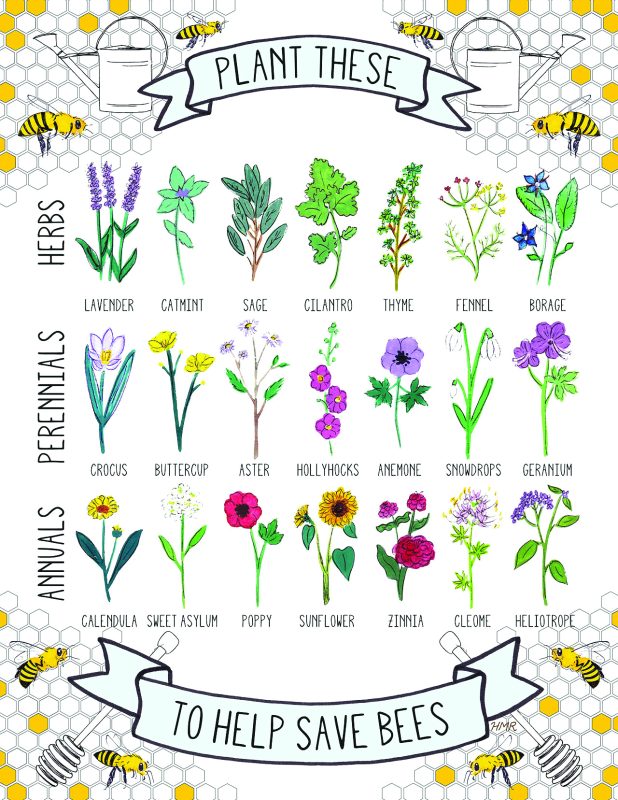
One of the largest threats to bees is a lack of safe habitat where they can construct hives and find a variety of nutritious food sources. By planting a bee garden, you can create a safe haven for bees with pollen- and nectar-rich flowers.
Bees are attracted to large patches of flowers, so plan on providing a diversity of pollen and nectar sources native to your area that bloom at various times during the year.
Eastern Sierra Land Trust prescribes planting native wildflowers along with shrubs for additional diversity.
The Bee Conservancy is a nonprofit organization dedicated to protecting bees, safeguarding the environment through community-based education, research, habitat creation, and advocacy. The organization recommends:
1. Feed the Bees
Choose nectar- and pollen-rich flowers with a range of shapes, sizes, colors, and bloom times. Seek out locally native plants as often as possible, as they have evolved regionally and are well adapted to the climate, soil, light, and water conditions in that area. Many native bee species have coevolved to feed exclusively on native flowers and need them to survive.
2. Skip the Mulch
Seventy percent of the world’s bees — including bumblebees — live underground and need bare, mulch-free, well-drained, protected soil in a sunny area to create and access their nests. If mulching is absolutely necessary, use compost or leaves instead of wood, bark, or other bulky materials, and keep mulch layers thin — no more than half an inch.
3. Leave Stems Behind
Don’t cut stems to the ground after blooms expire. Instead, strategically trim them so that cavity-nesting bees can move in and lay eggs. Leave spent flowers up through the fall and winter so migrating birds can feed on seeds. Then, in spring, trim stems at heights ranging from 8 to 24 inches high to provide homes for species such as mason bees.
4. Say No to Pesticides
The best way to avoid pest issues is to have healthy, resilient plants, which is why we recommend planting native species, which are best suited to thrive in the sun, water, and soil of a local ecosystem. If possible, avoid use of pesticides. But if you must use a pesticide, choose a targeted organic product, and always avoid applying pesticides when flowers are blooming or directly to the soil. Provide a source of pesticide-free water.
Refer to Internet sites on the subject for additional detailed information.
Talk to your neighbors, family, and friends about your bee garden project. By working together, you can help keep pollinators thriving throughout the North State!