
By Jim Moore
Imagine enjoying a hike through some flat pristine mountain meadowlands, and seeing ahead in the near distance a pond reflecting the blue of the sky. But when you arrive it is not the blue of the sky but a carpet of small, low growing, mostly blue flowers growing in an area of the meadow submerged under about an inch of water. Such was my first encounter with Bach’s Calicoflower (species Downingia bacigalupii) within the Cascade range in Lassen County. My next encounter with this wetland beauty was a few years later in a very un-pristine pond area that had recently dried up: the old mill pond of the long gone Red River Lumber Company in Westwood. Nowadays, the old mill pond is mostly a seasonal pond, filling up in the early spring, and becoming mostly dry by early summer.
It is this submergence under water, and then the drying up process that is key to the Bach’s Calicoflowers survival. Being an ‘annual’ species, this flower begins anew each year from seed produced the previous year. However, the seed can only germinate underwater; and produce good seed on drier ground. Thus it is dependent on meadows, ponds, and vernal pools, that undergo a brief period of temporary water submersion. The seed can stay viable during years of drought until again submerged under water.
Bach’s Calicoflower is also totally dependent on native solitary wild bees for cross pollination. Although each flower has both stamens (male) and stigma (female); they cannot self pollenate because the pollen bearing stamens become viable first, while the seed bearing stigma does not become viable until
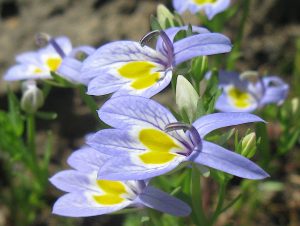
after the pollen is no longer viable. Fortunately, the flowers do not all bloom at the same time; so there is usually plenty of viable male-stage and female-stage flowers for the bees to accomplish their mission. The primary color of the flowers can vary from pale blue to purplish, with the yellow spots varying to a more orange color. Eventually, the one inch pretty flowers fade away; the small, under 12 inches tall, plants turn brown, and the seed pods burst open scattering the seed.
Bach’s Calicoflower is a member of the bell flower family Campanulaceae. Its range in California is primarily montane north of Lake Tahoe up into southern Oregon and locations scattered eastward up into western Idaho. Due to its habitat dependencies Bach’s Calicoflower may not be often seen by many outdoor hikers; therefore I recommend an online tour of the eleven Downingia Calicoflower species; and also their relationship with California’s endangered seasonal vernal pool habitats. It is also a wildflower that may be difficult to raise from seed in the home garden. Bach’s Calicoflower was named after the botanist Rimo Bacigalupi, the first curator of the Jepson Herbarium at UC Berkeley; and he was affectionately called ‘Bach’ by his students.